My relationship with books has always been… complicated
If you’d told my younger self that one day I’d happily walk home from the library with a bag full of books, I wouldn’t have believed you.
I’m dyslexic, so my relationship with books and reading has always fallen into the “it’s complicated” category.
As a child, every word, page and chapter felt like a huge achievement. Finishing a book wasn’t something I took for granted; it felt like climbing a mountain. I kept every book I’d finished like a trophy because each one represented determination, perseverance and a quiet victory.
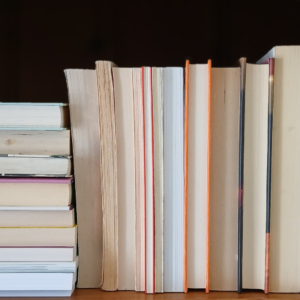
These days I borrow most of my books from the local library, so instead of keeping them on a shelf, I’ve started taking photographs of the ones I’ve finished before I return them. It makes me smile because, in a way, I’m still celebrating each little milestone.
When books stopped feeling safe
Reading never felt relaxing.
It felt like work.
Like many children, I remember the ritual of reading aloud in class. For me, it wasn’t just a little nerve-racking.
It was exhausting.
While someone else was reading, I wasn’t really listening to the story. I was desperately trying to work out where my paragraph began, mentally rehearsing unfamiliar words and hoping I wouldn’t stumble when it was my turn.
Around that time, I had recently been diagnosed with dyslexia. One day, a supply teacher encouraged me to read aloud by saying, “Don’t worry that you’re dyslexic, just have a go.”
I know she meant to encourage me.
But hearing those words in front of the whole class filled me with instant embarrassment. I can still remember the hot flush creeping across my face. At ten years old, all I wanted was to blend in, not stand out.
Looking back, I don’t think books ever felt unsafe because of one teacher or one lesson. They felt difficult because reading demanded so much concentration, and experiences like that quietly taught me to associate books with anxiety as well as effort.
School placed high expectations on all of us, and I placed even higher expectations on myself. I wanted to keep up. I wanted to prove that I was capable. Looking back, I think I spent much of my education fighting an unseen battle, trying to hide the effort it took simply to do what others appeared to do with ease.
Then came university, followed by work.
Reading became something I had to do.
Textbooks.
Research papers.
Clinical notes.
Reports.
Journal articles.
More words. More concentration. More effort.
Without really noticing, I stopped thinking of books as stories and started seeing them as tasks.
The small permission that changed everything
The turning point didn’t arrive with a dramatic life event.
It arrived quietly, through one simple act of permission.
I gave myself permission to read the stories I wanted to read instead of the books I thought I should read.
I stopped worrying about whether a book was educational enough, worthy enough or likely to improve me. Instead, I chose books because they sparked my curiosity, made me smile or promised to transport me somewhere else for a little while.
Then I discovered another wonderfully liberating idea.
I didn’t have to finish every book.
Discovering the phrase DNF (Did Not Finish) was surprisingly freeing. If a story wasn’t for me, I could simply close the book and return it to the library.
For someone who had spent years believing that perseverance was always the answer, learning that it was okay to stop felt like a tiny act of rebellion.
And it was wonderfully liberating.
Falling in love with reading
Somewhere along the way, something unexpected happened.
I fell in love with reading.
In fact, I’d go as far as saying I’m now in a deeply committed relationship with books.
They are somewhere I can escape.
Somewhere I can find solace, comfort and inspiration.
The books I find myself returning to are often about ordinary people living ordinary lives. Sometimes there’s a little magic thrown in too, but they’re always filled with familiar emotions. People who love deeply, make mistakes, face challenges they didn’t choose, doubt themselves, fail, begin again and slowly discover who they’re becoming.
Perhaps that’s why they resonate so much.
Because they remind me of us.
The extraordinary hidden inside ordinary lives
The more I read, the more I noticed something.
The everyday can so often be extraordinary if we give it our attention.
We tend to think heroes belong in epic adventures, but I don’t think that’s true.
I think we’re all the heroes in our own stories.
We all experience joy and disappointment, courage and fear, grief and hope. We care for the people we love. We make difficult decisions. We face challenges we never expected and somehow keep putting one foot in front of the other.
Our stories may seem ordinary to us because we’re living them every day.
That doesn’t make them any less remarkable.
It was never really about books
Looking back, I realise the greatest gift wasn’t rediscovering reading.
It was rediscovering joy.
The quiet kind.
The kind that waits patiently on a library shelf.
The kind that reminds you that an ordinary afternoon spent reading can be enough.
It was giving myself permission.
Permission to choose joy over obligation.
Permission to read slowly.
Permission to leave a book unfinished.
Permission to follow curiosity instead of expectation.
Permission to enjoy stories simply because they make me feel something.
And I can’t help wondering…
How many other “shoulds” do we carry without ever questioning them?
How many things have we quietly stopped doing because they no longer seemed useful, productive or important enough?
Perhaps the smallest permissions lead to the biggest changes.
Mine started with a library book.
And perhaps that’s what I’ve been wondering ever since.
What parts of ourselves have we quietly left behind because life convinced us they weren’t important enough?
I’d love to hear from you
Have you ever given yourself permission to rediscover something you once loved?
Or perhaps there’s something you’ve quietly stopped doing because life became busy and it no longer felt important enough.
I’d be genuinely interested and honoured to hear your story.
And before you go… if you’ve read a book recently that you couldn’t put down, I’d be keen to add it to my ever-growing library wish list.
Email me at mo@verbenawave.co.uk
A gentle next step
If this resonated with you, I’d love to stay in touch.
Once a month I write a gentle newsletter filled with reflections, everyday observations and quiet encouragement. It’s a slower, quieter space than social media, and I’d be so happy to welcome you there.
If you’re looking for a gentle place to begin, you can also download my free 5-Day Gentle Return to Yourself guide—a series of small invitations to pause, notice and reconnect with yourself.
And if you’d like to explore the journals, art and paper goods I create, you’ll find them waiting for you via my website.